Showing posts with label Composing and Arranging. Show all posts
Showing posts with label Composing and Arranging. Show all posts
Monday, September 14, 2015

Friday, September 12, 2014
Breaking down different genres
Today's post is about how to break down different types of music so you can learn from them or just straight copy them. Last week I talked about why you should learn different types of music and today I'll go over how. Music has a few elements and if you can figure out how each applies to a genre you can usually come up with something that comes pretty close to that style.
The first thing you should do is listen to a variety of songs in that style. Then answer the following questions below for your chosen genre.
1). Instrumentation
What instrument a are used in this genre? In rock music it will usually be drums, electric bass, electric guitar, and vocals. Of course some sub-genres will have keyboards, horns, etc this is the generic rock sounds. Of course it's great to experiment and add or subtract instruments, but the more you do this the less it will sound like the original genre. I've heard, double basses, glockenspiels, violins and saxophones in rock music, but a song consisting of only those instrument a won't be rocking very hard.
2). Rhythm
What time signatures does it use? Are the songs mostly 3/4, 4/4, 12/8, etc? What rhythms do the drums play? Is the bass drum on 1 & 3? Is the snare drum on 2 & 4? What rhythms is the keyboard playing? Whole notes, syncopated 16th notes, steady 8th notes, etc. Answer these questions for every instrument and you should come up with something that sounds close to the genre you've chosen. Also keep in mind the tempo. You won't find many slow 40bpm metal songs or 270bpm disco songs.
3). Melody
Are the songs mostly fast with a lot of movement in the melody or do they have lots of long sustained notes. Does the melody stay around the same few notes or does it go from very high notes to very low notes. Even the scale can be important. What would the blues be without the blues scale. When trying to replicate music from other cultures this is even more important. Ex. If you want to make music with a middle eastern flavor try the harmonic minor scale(its 5th mode).
4). Harmony
Many types of music have common chord progressions and by using them you"ll can save yourself a lot of time. Some genres such as the blues are defined by their chords. Some genres such as funk will can stay on 1 chord for the whole song, while a jazz song might go through 2 chords and 1 key every measure. A lot of ethnic music(non-European) doesn't use chords at all. They'll drone on one tone and use that instead of a chords.
5). Form
The form of a song is very important too. The blues form is usually 12 bars that repeats indefinitely, where as jazz is usually AABA. Study these forms and it will help you understand how these genres work. Modern dance music usually has a laid back intro that moves into a slightly higher energy section. Then comes the riser and finally the drop. After that there is a cool down section and then finally another drop. The reason this form exists is because it helps hype people up, but still gives them time to rest so they aren't going hard for 7 min straight. With jazz you don't have to worry about this, so different forms are used.
6). Nuance
This is one of the more difficult parts to get right. Every genre has certain ways they do things and if you don't adhere to them your music will sound inauthentic. Think of an opera singer and and R&B singer. If you took the best singers in each genre and switched their songs it would be a disaster. The way each uses vibrato, bends etc. is completely different. As another example think of the violin and the fiddle. These little things can make all the difference and if you want to add the flavor of another genre to your music, this is the 1st place you should look.
This was a basic over view of how to break down different genres, but next time I'll try to actually give an example. Until then leave a comment below and if you'd like to request a genre breakdown let me know.
Friday, September 5, 2014
Why diversify your musical portfolio?
Today I'd like to talk about the benefits of not only listening to different types of music, but also trying to make it.
Imagine if you lived in a world where all you could eat was food from your area. Just think of how boring that would be and how quickly you'd get sick of the same 4 or 5 foods.
Most people understand expanding their taste pallet, but won't try the same thing when it comes to music. Although there are people who listen to different types of music, there aren't many people who try to make different types of music. I'll list some reasons to try making different types of music.
1). The more types you can make the more work you can get.
2). 99% of creativity is combining different things together. The more you know the more combinations.
3). You can play with more people.
4). What you learn from one type of music can be carried over to another.
5). It's fun to learn new things.
I know this was a short post, but next time I'll talk about the how part of learning new styles of music.
3). You can play with more people.
4). What you learn from one type of music can be carried over to another.
5). It's fun to learn new things.
I know this was a short post, but next time I'll talk about the how part of learning new styles of music.
Friday, August 22, 2014
Songwriting: melody first
Last time I talked about starting with chords and then adding a melody. This time we're going to reverse that and start with a melody.
Obviously you can just do this by ear, but there is a faster way. First find the key of your melody. After that's done try to determine if your melody is major, minor or perhaps some sort of modal tonality. Once you know this, look at your melody and try to find the strong notes of each measure. Here is a melody I composed quickly. It's in the key of C major,

I'm sure you're thinking, how do I know which ones are the strong notes. Look for long notes, notes that occurs on down beats or notes that are repeated. Of course use your ears, but in general those tips will help you identify them. Here are what I chose as the strong notes, but keep in mind this is more art than science, so it's possible to come up with different notes than what I have here.

Now you should have 1 or perhaps 2 strong notes for every measure of you melody. Once you have that look at the chords in the key you found before. Take the notes that make up the chord and assign them to measures containing those strong notes. Of course this doesn't have to be random. Use your ears and think of common progressions that sound good. After you've done that insert the chords into your song and see if it fits your melody.

I think it's best to consider the overall key and common chord movements. For example have the 1st chord be the Root major chord of the key and have the last be the V major chord of the key. Check out my post on common chord progressions for ideas. That said, you can try some new ideas and try to come up with something a little more original. Here I added some 7th chords with extensions to get a different sound.

Ultimately you have to decide for yourself though and as I always say let your ear be your guide. Also another method to use when there are few long notes is to look for arpeggios inside the melody as often then can be you guide. That's it for this article. I hope it helped and if you have any questions, leave them below.
Songwriting: Chords first
Ultimately you have to decide for yourself though and as I always say let your ear be your guide. Also another method to use when there are few long notes is to look for arpeggios inside the melody as often then can be you guide. That's it for this article. I hope it helped and if you have any questions, leave them below.
Songwriting: Chords first
Saturday, August 9, 2014
Songwriting: Chords first
So you have a chord progression that you think sounds awesome and maybe you even have a rhythm. Despite that for some reason you can make a good melody. The easiest answer is to just listen to the chords and hum a melody.
 chords only
with melody
Now with some rhythms changed

I hope this gave you some ideas on how to write a melody when all you have is some chords. Of course there are some other techniques you can use to develop the melody, but hopefully this will give you a starting point.
Here is an example of a melody I came up with by humming over a typical chord progression.
with melody
This is so easy you I imagine most of you have already thought of it. Don't worry I'm not going to waste your time by only giving you that.
Another option is to look at the chord tones of the progression and then choose one note for each chord. That note will be you main melody note over that chord. When picking these notes it's usually best to pick notes that flow smoothly into each other rather than jump around although some jumps can make a melody interesting. Then embellish the main notes with shorter notes to add some interest. Also remember that you don't have to start on the 1 of every bar. Remember that even though this method is more mechanical than just humming you still need to let taste be the ultimate judge.
Just the chord tones
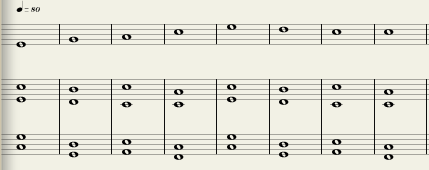
With some short notes added

Just the chord tones
With some short notes added
Now with some rhythms changed
I hope this gave you some ideas on how to write a melody when all you have is some chords. Of course there are some other techniques you can use to develop the melody, but hopefully this will give you a starting point.
Next time I'll go over how to start from a melody and then add chords to that.
Which comes first: Melody vs Chords
Songwriting: Melody first
Which comes first: Melody vs Chords
Songwriting: Melody first
Thursday, July 31, 2014
Which comes first?
A common problem many songwriters and composers have is whether to write the melody first or the harmony. I think most people have a way they like to do things and they don't often deviate from it. I however think both are important and both have strengths and weaknesses.
When I first started I would try to write a melody and then fit harmony to it. This didn't work well because I didn't know enough about song structure or harmony to make the rest of the song fit my melody. Then I tried writing the harmony first(after studying for a bit). I had a bit more success, but now my melodies were weak and I could hide that fact sometimes, by writing a lot of different harmonies and adding unique rhythms, but I couldn't write a nice melody to a simple set of chords.
I finally realized that I need learn to write both ways. I know some people are thinking, "why learn to write another way? What is the point?". One great reason is that it opens up a lot if possibilities as far as what songs you can write. If you can only write melodies it might be hard for you to find interesting harmonies to fit your melodies. Most people sing melodies that fit into 1 key and they don't have many interesting notes.
On the other hand if you only write harmonies it might be hard to make a melody that sounds good. Even if you can make one, can you make one that flows together with the rest of the song, without sounding like a bunch of disjointed melody fragments.
In the next few weeks I'll go over how I write songs starting with melodies and starting with chords.
Songwriting: Chords First
In the next few weeks I'll go over how I write songs starting with melodies and starting with chords.
Songwriting: Chords First
Monday, July 21, 2014
Common progressions in popular music II
The Jazz Progression(ii7-V7-I)
This is the most common progression in jazz by far. Almost every song in jazz uses this multiple times. There are whole songs built on nothing but this progression. Of course it can be used for all types of music, but it is THE jazz progression. It is also often used to change keys.

The Minor Jazz progression(ii7b5-V7-i)
This is the same as above, but in a minor key. It sounds darker it's often combines with the above progression to form whole songs. This is a good way to transition from a major key into the minor key smoothly. It not only sounds good, but it's useful.

The Carlos Santana secret chord progression(ii-V7)
This is the same as the jazz progression, but without the last chord. These 2 chords can repeat indefinitely and as long as you have a nice rhythm to go with it people won't get bored. This is named after the Frank Zappa song of the same name. I wonder how Carlos felt about Frank exposing his secret. On another note this is a popular way to produce a dorian progression.

(sorry I forgot the chord symbols. They're Dm7 and G7)
The School dance progression(I-vi-IV-V)
This progression is a staple of 50's and 60's pop music, especially ballads. That said it can still be used now as long and you use modern instruments and rhythms. Play it in 12/8 to really bring out that school dance feel. This is a great progression for major keys and can hold the interest of people without becoming boring.

Dramatic pop turnaround(IV-iv-I)
This is usually used in the middle of a song when you need something dramatic to take you into the next section. It's a bit cliche, but effective. This isn't one of those progressions you play over and over again it's just a little something you can add for some spice.

(check 2:51)
Minor line cliche(i-imaj7-i7-i6)
This is used in a variety of songs and its very effective when you want to stay on one minor chord for a while, but don't want to bore people to death. Tons of famous songs use this. Throw this in during long droning minor chords to keep people from falling asleep.The basic idea is that one note moves down chromatically(in this case the top note).

part 1
Tuesday, July 8, 2014
Seeing the big picture(the overall effect)

I've gone over most of the technical aspects of arranging in my previous posts, but now I thought I'd get into why arranging is important. I'm sure you've all heard remixes of songs or covers of songs. Some of them are better than the original, some are worse and others are simply different. There are a lot of things that can make one arrangement more enjoyable than another and of course everyone has different tastes, but I'll go over some basic ideas on creating interest and different effects.
Use pauses and breaks- This may seem cliche and it is, but it works. Try dropping a beat or a whole measure. Once the music comes back in people will go crazy. Make sure this comes at an important point in the song, for maximum impacts. Good places for it are the measure before the verse goes into the chorus or in the middle of the 2nd or 3rd verse. Anyplace where you think people are getting bored and you need them to get excited again is a good place.
(Listen for the breaks at 0:48, 2:53, 3:23)
Change instruments or parts - Adding or deleting instruments can add some interest to your songs and can creating an sense of building to an otherwise boring and static arrangement. Try adding some strings during the 2nd verse, or add some percussion during the chorus. You can also have some instruments play different parts. For example during the 2nd verse have the guitar double the keyboard line or have a 2nd guitar double the main riff an octave higher or lower. All of these things can add a small change that is just enough to keep things interesting without changing the feel of the song. Sometimes something as small as having the drummer switch from the hi hat to the ride cymbal can add something to a song.
(The intro is only the orchestra, followed by the melody played by the oboe, then the woodwinds and finally the guitar enters. This is a beautiful arrangement)
After chorus break down- This is another old trick that works almost every time. After the 2nd chorus of a song or any high point, drop the energy, by adding a quiet section with sparse instrumentation. Then after a period of 4 to 16 bars ramp the energy up and your listeners will go nuts.
(The break down comes in at 3:16)
Style and instruments- Before you start to record or perform your song, think about the style of your song and also the instruments you are using. In some cases you might be limited by things like money, human resources, etc, but most of the time you will have some flexibility with this. Think to yourself, what type of emotion should this song convey and are the instruments/styles I'm using evoking that. For example a song that is angry and aggressive might not come off too well with 2 acoustic guitars and vocals. That's not to say that it can't be done, but it puts all of the responsibility on the performers. If that same song is done by a rock band, the drums, driving rock bass and crunchy guitars will bring you half way there even without great performances. Sometimes it's nice to have the lyrics/singer/lead instrument be the polar opposite of the arrangement, but often people just do this out of laziness or a lack or knowledge. There is no reason to be locked into a genre in 2014. Nobody is going to go berserk because you have a blues song and a bossa nova song on the same album. Explore your options.
(The orginal version)
(The arrangement that is generally acknowledged to be better. Notice how the rock feel and the guitar tone adds an aggressiveness to the song and propels it forward.)
Opposites are attractive- Often times during songs you'll have different instruments doing different things. The question is, what should you have them do? The answer is often times, the opposite of something else. For example if you have a lead guitar and a singer, while the singer is singing the guitar should either be playing chords, a light riff or not at all. However when the singer pauses, the guitarist should play a fill. Singer on, guitarist off. Singer off, guitarist on. If you listen to reggae you'll notice this happens often with the bass and the guitar. The bass on the down beats and the guitar on the off beats. The same happens between a piano and a guitar. If the guitar is playing a riff on the low strings the piano plays high. If the guitar part is busy the piano part is sparse. This is a good way to arrange a song with lots of different instruments.
(Listen to how the vocals and guitar trade off)
(Bach is a master at trading melodies back and forth between instruments)
Melody switch- Have a new instrument carry the melody and it works even better if you can do this while a new melody is playing. Remember you can change things around slightly and people will still be able to recognize the melody as long as it's similar to the originally melody. For example have your guitar play the chorus melody during the 2nd verse, but change a few of the notes so the match the current chords.
(Listen to the melody repeated using different insturments at 0:00, 0:25, 1:50, 3:09, 3:28, etc. Click here to read about more crazy stuff in Gentle Giant songs)
Keep things dynamic- For a short song there isn't much time for your listeners to get bored, but for anything over about a minute you're going to need some variation. Of course you'll be varying the chords and the melody, but there are money other things you can change too. Try changing volume between sections, or the drum, bass, guitar part. Sometimes even switching the guitar part and the piano part can create some interest. Also keep in mind the instruments like electric guitars and keyboards can drastically change the way they sound. If your verse is using a clean, chorused guitar sound, try a slightly distorted sound for the chorus or bridge. Doing things like this helps create interest or increase/decrease energy.
(Listen to how everything comes in quiet at 1.36)
Anyway I hope you enjoyed this series. If you have any questions leave a comment below and check out some of my music at productiontrax.com
Part 1 - Thoughts on Arranging
Part 2 - Timbre
Part 3 - Rhythmic clarity
Part 4 - Harmonic clarity
Part 1 - Thoughts on Arranging
Part 2 - Timbre
Part 3 - Rhythmic clarity
Part 4 - Harmonic clarity
Friday, June 27, 2014
Timbre
Timbre is defined as the color or tone quality of something. A guitar, flute and trumpet can all play the same note, but the timbre will sound very different. How does this relate to arranging? Well, not only is arranging about not making things sound disjointed and horrible, it is also about making things sound good and evoking moods. Different instruments can help you do that.
Now I'm sure you're wondering how can I use this. One effective way this is used is by having melodies(or harmonies) doubled by different instruments. These instruments should have different qualities, so that the overall sound is enhanced.
As an example think of a kick drum and a guitar. The kick drum has a loud, percussive, powerful attack, but not tone to speak of and no sustain. A guitar has sustain and tone, but it's hard to get a lot of power out of a guitar. However when they are playing in unison they create a powerful attack that can rip your head off.
Another common example is doubling a tuba with a bass trombone. The tuba has a kind of "farting" sound that, although it is low doesn't contain a lot of power. The bass trombone has power, but it doesn't have the same low fullness. Combined together however the amount of brown notes will have audiences rushing the toilets. A good example of this recently was "The battle at the wall" during season 4 of game of thrones.
Another common thing to do is to double a sustaining instrument without much attack with something percussive. The percussive insturment helps give the line punch and definition while the other insturment give it tone.
(Check out the middle section where the guitar, synth, drums and xylophone double the same line)
One final example is the use of talk boxes. The earliest example I know of is Frampton cones alive . However don't be fooled into thinking that this is an old technique that nobody uses anymore. Grammy winners Daft Punk used it all over their last album.
One of the great things abound living in the year 2014 is the fact that you have cheap software synths everywhere and you can experiment endlessly with different timbres. Try combining different types of oscillators and even shifting their octaves until you find a sound that suits you. You can also mix acoustic with electronic elements to come up with all new sounds.
Don't be afraid to experiment with different combinations of instruments. They often lead to new and interesting textures and other times they can be great problem solvers. Often times of you want you melody to be more powerful, doubling it with something more percussive will work. The opposite also holds true. Doubling something with a flute(or another woodwind) will lighten it up. There is a whole world of sound out there for you to experiment with, so play around with different combinations and have fun.
Check out some of my songs and arrangements on the side of this page or at productiontrax and leave a comment below.
Part 1 - Thoughts on Arranging
Part 3 - Rhythmic clarity
Part 4 - Harmonic clarity
Part 5 - Seeing the big picture
Now I'm sure you're wondering how can I use this. One effective way this is used is by having melodies(or harmonies) doubled by different instruments. These instruments should have different qualities, so that the overall sound is enhanced.
As an example think of a kick drum and a guitar. The kick drum has a loud, percussive, powerful attack, but not tone to speak of and no sustain. A guitar has sustain and tone, but it's hard to get a lot of power out of a guitar. However when they are playing in unison they create a powerful attack that can rip your head off.
Another common example is doubling a tuba with a bass trombone. The tuba has a kind of "farting" sound that, although it is low doesn't contain a lot of power. The bass trombone has power, but it doesn't have the same low fullness. Combined together however the amount of brown notes will have audiences rushing the toilets. A good example of this recently was "The battle at the wall" during season 4 of game of thrones.
(Great low horn blast at 0:35)
Another common thing to do is to double a sustaining instrument without much attack with something percussive. The percussive insturment helps give the line punch and definition while the other insturment give it tone.
One final example is the use of talk boxes. The earliest example I know of is Frampton cones alive . However don't be fooled into thinking that this is an old technique that nobody uses anymore. Grammy winners Daft Punk used it all over their last album.
One of the great things abound living in the year 2014 is the fact that you have cheap software synths everywhere and you can experiment endlessly with different timbres. Try combining different types of oscillators and even shifting their octaves until you find a sound that suits you. You can also mix acoustic with electronic elements to come up with all new sounds.
Don't be afraid to experiment with different combinations of instruments. They often lead to new and interesting textures and other times they can be great problem solvers. Often times of you want you melody to be more powerful, doubling it with something more percussive will work. The opposite also holds true. Doubling something with a flute(or another woodwind) will lighten it up. There is a whole world of sound out there for you to experiment with, so play around with different combinations and have fun.
Check out some of my songs and arrangements on the side of this page or at productiontrax and leave a comment below.
Part 1 - Thoughts on Arranging
Part 3 - Rhythmic clarity
Part 4 - Harmonic clarity
Part 5 - Seeing the big picture
Saturday, June 21, 2014
Review of Kirk Hunter Diamond Symphony Orchestra
Recently there was/is a sale on most of Kirk Hunter's products. I already own a few, but the sale was so good I couldn't resist. I picked up Diamond which is a complete orchestra including woodwinds, brass, strings and percussion.
First I'll talk about the sound. The sound of the strings are better than I expected, although as I said before I already have some string samples. The woodwinds are also good although there seems to be a problem with the flute. Everything else sounds good and responds well. One of the reasons I bought this library is because of the piccolo and it doesn't disappoint. The horns sound pretty good, but they are a little aggressive for my taste. Also the library includes reverb. but it isn't baked into the samples, so you can adjust it as needed or take it off completely. This can be good or bad depending on your perspective, but personally I prefer things this way.
Second, the features. Most of the patches have TEVC programming which gives them the ability to use keyswitches for articulations and adjust certain parameters giving the patches much more flexibility. Unfortunately not all of the patches have updated programming(the bass trombone), but most do which makes them easy to work with.
Overall it's a great value and the fact that it was recorded dry let's you blend it with other libraries without too much trouble. Anyway, check out the short song I wrote with it below. Leave comments and questions below.
First I'll talk about the sound. The sound of the strings are better than I expected, although as I said before I already have some string samples. The woodwinds are also good although there seems to be a problem with the flute. Everything else sounds good and responds well. One of the reasons I bought this library is because of the piccolo and it doesn't disappoint. The horns sound pretty good, but they are a little aggressive for my taste. Also the library includes reverb. but it isn't baked into the samples, so you can adjust it as needed or take it off completely. This can be good or bad depending on your perspective, but personally I prefer things this way.
Second, the features. Most of the patches have TEVC programming which gives them the ability to use keyswitches for articulations and adjust certain parameters giving the patches much more flexibility. Unfortunately not all of the patches have updated programming(the bass trombone), but most do which makes them easy to work with.
Overall it's a great value and the fact that it was recorded dry let's you blend it with other libraries without too much trouble. Anyway, check out the short song I wrote with it below. Leave comments and questions below.
Wednesday, June 11, 2014
Common progressions in popular music
I thought I'd go over various chord progressions used in popular music with this post. Chord progressions are one of the fundamental aspects of western music and being familiar with chords and how move in progressions is very important. I know some people are thinking, why learn this or isn't better to just sit down with a keyboard/guitar and mess around until something interesting comes. Of course you can do that, but most of the time when people do that they end up reinventing the wheel needlessly. There is a reason why some chord progressions are popular. They sound good and bring about an emotion in people. A good reason to learn about chord progressions is that they allow you to invoke an emotion in people while still allowing you enough room to express yourself and be creative. For example Bob Marley's "No woman, no cry" and Journey's "Don't stop believing" use the same chord progression, but I doubt anyone would say they sound the same. Anyway, on to the good stuff.
I'm going to use Roman numerals for chords. For example I, ii, iii,IV, V, vi, viidim. In C this would be C major, D minor, E minor, F major, G major A minor and B diminished. Uppercase numerals are major chords, lower case are minor and diminished chords are indicated by dim and augmented chords by aug. They might also have 7, 7(#9),sus, ect added to indicate any additions to the basic chord.
The Emotional Girl Chord progression(I-V-vi-IV)
I heard this progression called this once and although I don't agree completely it's as good a name as any. This chord progression is used in hundreds of pop, rock, and folk songs. In the key of C the chords would be C-G-A minor-F. For me the appeal of this progression is that it's a bit emotionally neutral. It can be happy without being too sweet and syrupy or cool without being sad and depressing. It's not as overpowering as some other progressions and can work in a variety of styles without sounding out of place.

The Blues chord progression(I7-IV7-I7-V7-IV7-I7-V7)
There are a million variations of this, but I'm sure everyone reading this is familiar with the sound. The great thing about the blues is that it can be used is so many ways. It can be slow and sad or fast and raunchy. There is a whole genre of music based on this chord progression, enough said. This progression is also common in classic rock music. Every musician should know this by heart.

The Minor blues chord progression (i-iv-i-VI7-V7-i-V7)
As with the above, there are tons of variations on this progression. This is a sadder darker version of the normal blues progression. If you want something really sad and emotional, try this progression. For extra emotion try this with a slow 12/8 time signature.

The Andalusian chord progression(i-bVII-bVI-V) or (i-bVII-bVI-bVII)
This is used in tons of hard rock songs. This is another minor chord progression, but it's not really that sad IMO, it's more aggressive and sometimes angry. This progression makes me want to walk down the street wearing a jean jacket and sunglasses. Lots of 80s hard rock and metal bands used this and often times instead of full chords they'll just use power chords. Many older songs use this also. It's extremely popular.

The Square chord progression (I-IV-V)
I'm calling this the square chord progression because it's old and not very hip. In fact it's a few hundred years old and is the basis for a lot of classical music. Despite it's age you still hear it quite often. It's a classic in a sense, so you'd be wise not to over look it. This is a very upbeat and happy progression that can work in a few different types of music.

The Reverse Square progression (V-IV-I)
This is a little higher on the cool factor. This isn't too popular now, but it's quite common in classic rock. This progression sounds happy without being too sweet and weak sounding. It reminds me a bit of country music and gives this a "down home" sort of feel. Well it least that's what it makes me think of.

I hope that was useful and don't worry there is more to come. I'll be going over more progressions that I hope will help you make better music. As always leave some comments below and if you have an idea or something you want me to answer, feel free to ask.
part 2
I'm going to use Roman numerals for chords. For example I, ii, iii,IV, V, vi, viidim. In C this would be C major, D minor, E minor, F major, G major A minor and B diminished. Uppercase numerals are major chords, lower case are minor and diminished chords are indicated by dim and augmented chords by aug. They might also have 7, 7(#9),sus, ect added to indicate any additions to the basic chord.
The Emotional Girl Chord progression(I-V-vi-IV)
I heard this progression called this once and although I don't agree completely it's as good a name as any. This chord progression is used in hundreds of pop, rock, and folk songs. In the key of C the chords would be C-G-A minor-F. For me the appeal of this progression is that it's a bit emotionally neutral. It can be happy without being too sweet and syrupy or cool without being sad and depressing. It's not as overpowering as some other progressions and can work in a variety of styles without sounding out of place.
The Blues chord progression(I7-IV7-I7-V7-IV7-I7-V7)
There are a million variations of this, but I'm sure everyone reading this is familiar with the sound. The great thing about the blues is that it can be used is so many ways. It can be slow and sad or fast and raunchy. There is a whole genre of music based on this chord progression, enough said. This progression is also common in classic rock music. Every musician should know this by heart.
The Minor blues chord progression (i-iv-i-VI7-V7-i-V7)
As with the above, there are tons of variations on this progression. This is a sadder darker version of the normal blues progression. If you want something really sad and emotional, try this progression. For extra emotion try this with a slow 12/8 time signature.
The Andalusian chord progression(i-bVII-bVI-V) or (i-bVII-bVI-bVII)
This is used in tons of hard rock songs. This is another minor chord progression, but it's not really that sad IMO, it's more aggressive and sometimes angry. This progression makes me want to walk down the street wearing a jean jacket and sunglasses. Lots of 80s hard rock and metal bands used this and often times instead of full chords they'll just use power chords. Many older songs use this also. It's extremely popular.
The Square chord progression (I-IV-V)
I'm calling this the square chord progression because it's old and not very hip. In fact it's a few hundred years old and is the basis for a lot of classical music. Despite it's age you still hear it quite often. It's a classic in a sense, so you'd be wise not to over look it. This is a very upbeat and happy progression that can work in a few different types of music.
The Reverse Square progression (V-IV-I)
This is a little higher on the cool factor. This isn't too popular now, but it's quite common in classic rock. This progression sounds happy without being too sweet and weak sounding. It reminds me a bit of country music and gives this a "down home" sort of feel. Well it least that's what it makes me think of.
I hope that was useful and don't worry there is more to come. I'll be going over more progressions that I hope will help you make better music. As always leave some comments below and if you have an idea or something you want me to answer, feel free to ask.
part 2
Monday, June 2, 2014
Rhythmic arranging
I thought I'd talk about rhythm in this post. Luckily rhythm is much easier to deal with and there are less ways to mess it up, but if you aren't careful it can still happen. One simple thing that can cause problems is flams. If you're a drummer I'm sure you know what a flam is, but if not I'll explain. A flam is when one note(usually percussion) is played quickly before another and with a lower volume. You can check it out below.
On drums this is cool, when it happens by accident with 2 different instruments it's not. The one of the worst places this can happen is between a kick drum and a bass. If your kick drum and bass guitar aren't playing complimentary rhythms, you can get flaming that can sound like mistakes. The bass and kick don't have to play the exact same thing, they shouldn't be fighting each other. Of course this can happen with any instrument, but with instruments it seems to cause more problems for whatever reason. Here is an example.

Here is another one with piano that sounds a bit strange and definitely lacks a groove.

Luckily there are some simple fixes. One thing you can try is having everything play the same rhythm or at least similar rhythms. In this example nothing sounds wrong or out of place and I don't think it would sound terrible in a song. However there are some improvments that could be made to make it groove a bit harder.

Now listen to the 2nd example. In the 2nd example the kick drum, bass and clavinet are playing similar rhythms, which gives this example more power.

Some people might like the 1st example better, but in certain situations and songs the 2nd idea works better. By having multiple instruments playing at the same time, you give those rhythms power.
Another thing that works well is what I call trading off. What I mean by that is when one instrument is holding a note another plays a lots of notes and vice versa. This is a fundamental arranging trick and you can hear it everywhere from pop to classical music. Here are some examples

Now here is a song I wrote a while back that uses the exact same technique through out.
I hope that gave you some ideas on how to go about putting together rhythms. Most of it is intuitive, but there are some techniques that help when you're at a lost. Also keep in mind that sometimes you might want things to sound chaotic and you can do the opposite of what I've suggested above. Below are some songs I believe are examples of good rhythmic arranging.
Listen to how all the instruments compliment each other and don't fight each other. Listen to the percussion on the left and right sides. Also take note of how at the end of each phrase he sings you can hear a guitar lick, horn stab or a string riff. During the keyboard solo listen to how all the instruments play together to create a powerful rhythm for the keyboard to solo over. This creates an interesting contrast to the light funky feel of the rest of the song.
I've been getting into Kill Paris recently. Here is an example of funkstep/glitch-hop which is simple but effective. If you listen to the bass during the drop it's playing a simple line that is locked in with the kick drum. Later another lead synth part comes in the plays the exact same thing as the bass just higher. On top of all of this notice how the synths drop out when the vocal sample come in which only makes their reappearance seem to hit even harder(which doesn't seem possible). The genius of this song is they found a good rhythm, had all the instruments follow it and then took it away before you got too tired of it. A simple idea, but when it comes together like this you can turn it into a whiplash inducing groove.
Listen to how the bass, kick, piano and guitar all lock in together into the same rhythm. This makes for a powerful arrangement and is present in most hard rock and heavy metal songs.
As always check out some of my songs and arrangements on the side of this page or at productiontrax and leave a comment below. I'll be back with more on arranging in a week or 2.
Part 1 - Thoughts on Arranging
Part 2 - Timbre
Part 4 - Harmonic clarity
Part 5 - Seeing the big picture
On drums this is cool, when it happens by accident with 2 different instruments it's not. The one of the worst places this can happen is between a kick drum and a bass. If your kick drum and bass guitar aren't playing complimentary rhythms, you can get flaming that can sound like mistakes. The bass and kick don't have to play the exact same thing, they shouldn't be fighting each other. Of course this can happen with any instrument, but with instruments it seems to cause more problems for whatever reason. Here is an example.
Here is another one with piano that sounds a bit strange and definitely lacks a groove.
Luckily there are some simple fixes. One thing you can try is having everything play the same rhythm or at least similar rhythms. In this example nothing sounds wrong or out of place and I don't think it would sound terrible in a song. However there are some improvments that could be made to make it groove a bit harder.
Now listen to the 2nd example. In the 2nd example the kick drum, bass and clavinet are playing similar rhythms, which gives this example more power.
Some people might like the 1st example better, but in certain situations and songs the 2nd idea works better. By having multiple instruments playing at the same time, you give those rhythms power.
Another thing that works well is what I call trading off. What I mean by that is when one instrument is holding a note another plays a lots of notes and vice versa. This is a fundamental arranging trick and you can hear it everywhere from pop to classical music. Here are some examples
Now here is a song I wrote a while back that uses the exact same technique through out.
I hope that gave you some ideas on how to go about putting together rhythms. Most of it is intuitive, but there are some techniques that help when you're at a lost. Also keep in mind that sometimes you might want things to sound chaotic and you can do the opposite of what I've suggested above. Below are some songs I believe are examples of good rhythmic arranging.
As always check out some of my songs and arrangements on the side of this page or at productiontrax and leave a comment below. I'll be back with more on arranging in a week or 2.
Part 1 - Thoughts on Arranging
Part 2 - Timbre
Part 4 - Harmonic clarity
Part 5 - Seeing the big picture
Monday, May 19, 2014
Harmonic Clarity
Harmonic/Frequency clarity
I thought I'd start with Harmonic clarity first. It goes without saying that in any ensemble volumes should be adjusted correctly and correct harmonies are used. However even when you do that sometimes you'll find your song is muddy or there is something that doesn't sound right. I'll go over a few common problems.
Be careful not to exceed low interval limits. The lower you go the wider the intervals should be. Of course there are no absolutes , but in general this is true. I'll give some examples.

Some don't sound too bad and others sound like a muddy mess. Although all the notes are correct something sounds wrong.
Now here are some better voiced chords.

I just changed the bottom notes to octaves and then arranged the top notes accordingly.
Here are a few more examples of bad voicings followed by better versions.


I'm sure you're thinking, that's easy enough, but the hard part is remembering not to do this when you have multiple instruments playing. It's easy to voice your piano parts the correct way, but then once you add the guitar you end up with frequencies clashing all over the place. This is especially apparent when 2 instruments play on the downbeat of a measure. This is a common problem, so I'll give a few examples.

Although I've heard worse, something definitely seems off. In the 2nd measure the piano is playing a B and the Oboe is playing an A. These 2 notes are causing a congested sound. The same thing happens in the following bar also. Below is a version that has the piano playing a different chord voicing.

To be honest this version isn't ideal for me, but sometimes you can't always get what you want and sometimes you have to compromise. In general I think that if you have an extension like a 6th(the note A in this example) it should be in the melody(oboe) and not just the harmony. That said I believe it is an improvement. Below are some other ways to solve problems with arrangements.
Subtract notes- Instead of having the piano and guitar both play big lush chords have each play less notes and the combined sound will be better. Often times in jazz the piano or guitar will just play 2 notes and let the bass play the root of the chord. This leaves very little chance for clashes to happen since there isn't much to clash with. Funk music takes a similar approach and goes a bit further by having each instrument play its own rhythm/riff. Often times guitarists and piano players that are used to playing by themselves play these big chord voicings and then when they are playing in a band they tend to clash with the other instruments. Sometimes all it takes to fix this is have the guitar player use only the top 4 strings or have the piano player take their left hand off the keyboard.
Change the rhythm- As long as the clashing notes aren't playing at the same time things will be fine. Sometimes shortening a few notes will be enough to fix things and other times it's better to change a chord into an arpeggio. Arpeggiating chords can be used as a way to avoid clashing notes when you can't change octaves. You can also make a riff that will outline a chord which is useful for funk, rock or metal.
Change the octave- Sometimes it's as simple as changing the octave of a note. The minor 2nd is pretty dissonant, but the minor 9th is much less so.
Hopefully that helped a little bit, but as always let your ear be your guide because if it sounds good it is good. Also check out some of my songs and arrangements on the side of this page or at productiontrax and leave a comment below.
Part 1 - Thoughts on Arranging
Part 2 - Timbre
Part 3 - Rhythmic clarity
Part 5 - Seeing the big picture
Thursday, May 15, 2014
Thoughts on Arranging
A friend asked me recently to write a bit about arranging, so I thought I'd share my thoughts on it. This is a big subject, so I'll just give a brief overview of how I go about it.
My way of thinking about arranging is that its similar to putting together a puzzle. Unfortunately just like a puzzle, the more pieces you have the more difficult it becomes. The main things to worry about are
Timbre- The overall tone of the song and instruments. Some instruments sound really good together and others don't. Of course this is mostly subjective, but there are some cases where 1 instrument can completely mask another. For example I once tried to double a lead guitar part with a synth playing a sine wave. The sine was was pretty much inaudible unless I turned it up to ridiculous levels.
Rhythmic clarity- Everyone loves a good groove and there are tons of songs(particularly funk) that have almost every instrument playing a different rhythm. However if not done properly the groove falls apart and in the worst case scenarios it sounds like the players are making mistakes.
Harmonic/Frequency clarity- This relates to how a chord is played. Of course the notes of the chord are important, but equally important is what octave they are played in relation to the other notes. If proper care isn't taken, muddiness or seemingly wrong notes will pop up. Also if you have too many instruments playing in the same frequency range harmonic masking can occur. This can happen with things like 7 string guitars and basses, pianos and basses, pianos and guitars, 2 guitars, etc. Having too many instruments in the same range will cause a song to sound muddy and can obscure the instruments. Whats the point of writing/playing a part of listeners can't hear it.
Overall effect- The whole point of writing music is to express yourself and bring about feelings in the listeners. Many people think of arranging in a purely technical way, but arranging can be just as creative as song writing. There is some tried and true tools/tricks that bring about the emotions in listeners and these can make those tired old chord progressions, beats, melodies, etc come to life. Arranging can be used to add musicality to songs that otherwise would be stale and a bit boring.
Anyway, in the future I'll try to explore all of these in greater detail. Until then check out some of my songs and arrangements on the side of this page or at productiontrax. Leave me some comments below.
Part 2 - Timbre
Part 3 - Rhythmic clarity
Part 4 - Harmonic clarity
Part 5 - Seeing the big picture
My way of thinking about arranging is that its similar to putting together a puzzle. Unfortunately just like a puzzle, the more pieces you have the more difficult it becomes. The main things to worry about are
- Timbre
- Rhythmic clarity
- Harmonic clarity
- Overall effect
Timbre- The overall tone of the song and instruments. Some instruments sound really good together and others don't. Of course this is mostly subjective, but there are some cases where 1 instrument can completely mask another. For example I once tried to double a lead guitar part with a synth playing a sine wave. The sine was was pretty much inaudible unless I turned it up to ridiculous levels.
Rhythmic clarity- Everyone loves a good groove and there are tons of songs(particularly funk) that have almost every instrument playing a different rhythm. However if not done properly the groove falls apart and in the worst case scenarios it sounds like the players are making mistakes.
Harmonic/Frequency clarity- This relates to how a chord is played. Of course the notes of the chord are important, but equally important is what octave they are played in relation to the other notes. If proper care isn't taken, muddiness or seemingly wrong notes will pop up. Also if you have too many instruments playing in the same frequency range harmonic masking can occur. This can happen with things like 7 string guitars and basses, pianos and basses, pianos and guitars, 2 guitars, etc. Having too many instruments in the same range will cause a song to sound muddy and can obscure the instruments. Whats the point of writing/playing a part of listeners can't hear it.
Overall effect- The whole point of writing music is to express yourself and bring about feelings in the listeners. Many people think of arranging in a purely technical way, but arranging can be just as creative as song writing. There is some tried and true tools/tricks that bring about the emotions in listeners and these can make those tired old chord progressions, beats, melodies, etc come to life. Arranging can be used to add musicality to songs that otherwise would be stale and a bit boring.
Anyway, in the future I'll try to explore all of these in greater detail. Until then check out some of my songs and arrangements on the side of this page or at productiontrax. Leave me some comments below.
Part 2 - Timbre
Part 3 - Rhythmic clarity
Part 4 - Harmonic clarity
Part 5 - Seeing the big picture
Subscribe to:
Posts (Atom)